Kiva Robots: A Bit Like Forklifts

Amazon is the biggest online retailer in existence. On some of their busier days, they've been known to receive more than 400 orders per second. Anyone who has ever worked in a warehouse can tell you that this is an absolutely astounding number. Even with warehouses all over, this would be a huge challenge for human workers. So, in 2012 Amazon purchased an army of robots for three quarters of a billion dollars.

The Kiva robots are like big, square Roomba robot vacuum cleaners, though they function more like forklifts. They're about 16 inches tall and weigh 320 pounds When a customer orders something on Amazon, a robot is dispatched with orders to retrieve the tall, thin square shelf that the item is on.
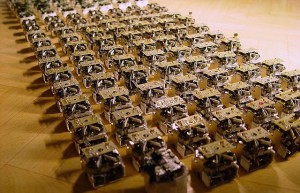
robotsThe Kivas roll through the Amazon warehouses, carefully guided and controlled by a central computer to avoid collisions. They scoot under shelves, stopping when they reach the programmed location and spin in place to lift the shelf. Then they pilot the whole shelf to a station where a human employee grabs the customer's order. The order then travels through an array of other steps to get to the customer.

Amazon has more than 15,000 of these robots in their warehouses right now, processing a majority of the orders. Establishing a testing a system for a warehouse can take quite a while, sometimes months. Amazon's engineers have to assure that the army of robots on the warehouse floor can move about without running into one another and toppling shelves over left and right, which is no easy task.

They also have to set the system up for prioritizing where to set shelves, in order to minimize retrieval times for the robots.

Surprisingly enough, the Kiva robots haven't resulted in job losses. Instead, the workers move from the picking-and-sorting jobs to train in other positions. In this scenario, when more robots are added, more work is created for the human workers. Seemingly: everybody wins. Plus, as anyone who has ever worked in a warehouse can easily attest, picking is a job tailor-made for robots.

The Lasting Architecture of Vastu Shastra

Indian architecture has one of the longest histories of any architectural school—or, at least, of any architectural philosophy. It's not like any society really ever stops building for a while, so they all have immensely long architectural histories.

Angkor WatIndia, however, has an architectural philosophy called Vastu Shastra. Rather than a rigid design philosophy telling you to do this and then do that, it's more a set of guidelines to help with maximizing space, sunlight, and movement within the space, while adding in Hindu and Buddhist beliefs. This all is characterized by square mandalas, which are very distinctive grid-like shapes.

Many of the greatest architectural achievements in human history were designed according to Vastu Shastra. Angkor Wat in Cambodia was designed according to that plan. (Fun fact: the live action version of “The Jungle Book” from the 1960s was partially filmed at Angkor Wat. Great movie.)

One theory holds that they developed Vastu Shastra as far back as 8,000 years ago; many ancient Indian archaeological sites conform to its design principals. It’s been in continual practice ever since, though it was ignored by a lot of architects during the British rule of India. As soon as the British got the boot, though, Vastu Shastra quickly started regaining its popularity.

Part of the reason Vastu Shastra has remained in use for so long is its flexibility. The design matrix allows for adaptation: with new building materials, in more crowded areas, and in non-square spaces. We’ve seen a major resurgence of Vastu Shastra in modern times—among both architects and homeowners in India—and its concepts are spreading all around the world.

Too often, people look at architecture, comment about how exotic it looks, and then just dismiss it as a novelty. People don't build like that, though. There is a philosophy behind every piece of architecture in history.

The End of the VHS Loop

BetaandVHSMaggie had me cleaning out the attic the other day, and I found a cardboard box filled with old VHS tapes. We hadn't used the VCR in something like a decade, but I managed to find it (in the garage, under five or six cans of paint) and hooked it up.

I went through some of our old home videos, and found that some worked perfectly fine and others didn't work at all. There didn't seem to be any real link between their age and how well they worked, either, so I decided to do some research.

There are lots of stories bouncing around the internet about how VHS tapes are supposed to stop working after ten years, or 15, or 20, but there doesn't seem to be any real consensus. People have written their anecdotes about all sorts of lifespans for the dumb things.

It turns out that there are a lot of reasons for the wildly different stories. First off, there was a lot of advertising done when DVDs came out—trying to convince people to switch from VHS to DVD, with the claim that VHS tapes wouldn't last very long.

And the conditions that cause the tapes to wear out vary wildly. VCR malfunction is the quickest cause, of course, but other factors include: rapid temperature swings, frequent use, low humidity, proximity to magnets and electronics, and storage conditions.

theDVDWhat makes it even more confusing is that many of the factors aren't even consistent. Infrequent usage can sometimes cause the tapes to fail, and frequent use can do the same thing.

The last movie released on VHS was “A History of Violence,” in 2006. I doubt that a copy of this will be the last movie ever watched in the format, of course: by that time DVDs had pretty much taken over the whole scene, leaving very little of a VHS market remaining. The “last view” honor will most likely go to someone's home movie, and probably within the next 50 years.

Arecibo: Peering Out

Built in the early 60s, the Arecibo Observatory in Puerto Rico is the largest radio telescope in the world, with a diameter of a thousand feet. It’s appeared in a James Bond movie, “Contact,” “The X-Files,” and any number of novels.

AreciboNumerous discoveries have been made from there, ranging from new knowledge about the planets in our own solar systems to the discovery of pulsars, the first planets outside our solar system and examinations of distant galaxies. Basically, I’m trying to say that it’s a really big deal.
Much of the motivation for building the radio telescope was actually military based—it was used to discover Soviet radar installations during the Cold War by, get this: listening for Soviet radar waves bouncing off the moon.

Nonetheless, it has also been one of the most important scientific research installations on Earth for much of its life. One of the most famous programs run out of Arecibo is SETI, or the Search for Extra-Terrestrial Life, which analyzes data from the telescope to try and find any alien radio signals.

You can actually help with that through SETI@Home, a computer program that lets SETI use your computer remotely to help perform calculations. I’ve been running it for years.

In recent times, the observatory has faced significant funding troubles, though it is managing to hold on and continue performing a bunch of worthy scientific work.

If you’re ever in Puerto Rico, you can actually visit the radio telescope. Though you can’t enter the labs or the various work spaces, there is a visitor center that provides a view of the dish, and is filled with interactive displays and exhibits. I went there once; it was definitely worth the trip.

Here’s a fascinating gallery of photos from the construction of the Arecibo radio.

Castles in Decline

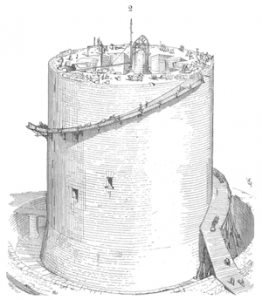
castleThe decline of the castle can be summed up in one word: Gunpowder. Really seems a bit simple to just leave it there, so here goes:

I generally avoid military history…always felt that people building things is more important to history than people destroying things. For any student of ancient architecture, though, castles are impossible to ignore.

Castles dominated Europe for more than 900 years. When someone thinks of the Middle Ages, castles are probably the first things on their mind.

There were two major types of castles. Not architectural types; I’m talking about the reasons the castles were built in the locations they were. Rural castles were the first type, generally placed in a location with some sort of important resource—fertile land, mines, mills, or maybe a major road or mountain pass.

The second type, urban castles, were built to control the local populace and maintain control over trade routes. All of them served as centers for administration and as the habitations of the nobility.

Castles were not the only medieval fortifications. There were plenty of different kinds of forts and garrisons and such. The key difference between castles and the other fortifications is that castles were actually used for administration.

Only a century after gunpowder gained common use did artillery grew to be a major threat to castles. From that point, the decline of the castle was not so swift as you might expect. People built a few good castles after this time, a few of them even constructed to resist artillery—massively thick walls packed with dirt, rubble, and other debris.

The true death knell actually wasn’t artillery actually destroying the castles by artillery. It was a loss of confidence in the castles. The nobility simply started moving out, into grand palaces and estates.

The fall of castles as the center of European life was one of the main reasons that larger standing armies became a necessity, and led to one of the bloodiest eras in European history.